The FIFA World Cup: History, English-Speaking Countries and 16 Memorable Moments
Discover the history of the FIFA World Cup, the role of English-speaking countries, and 16 memorable World Cup moments while improving your English reading skills.
SPORT
6/26/202615 min read
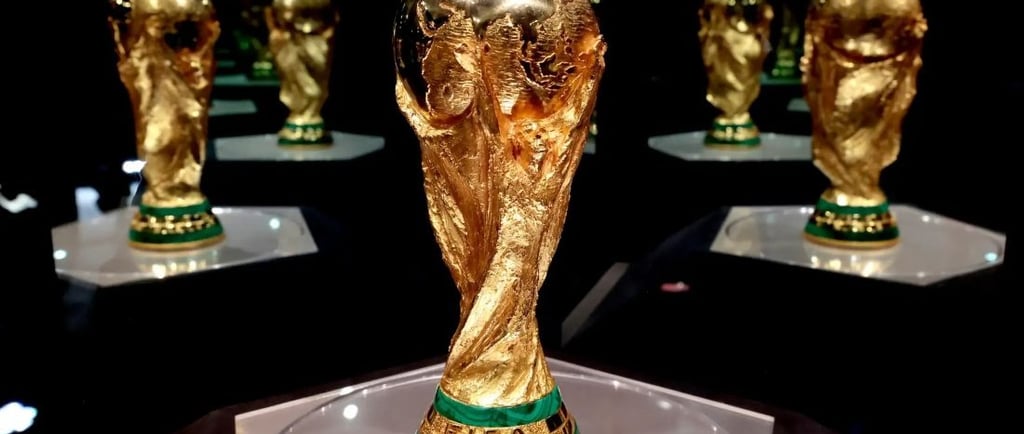
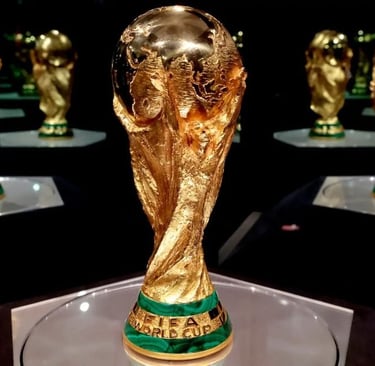
A Sport Article for Intermediate English Learners
Introduction
Right now, people all over the world are enjoying the 2026 FIFA World Cup, currently being played across the United States, Mexico and Canada. Despite all the football to watch, I hope you are still finding some time to study English! To help you, I've made this article — the second in my Learning English Through Sport series — all about the World Cup. (If you missed my first sports article, it was all about golf.)


The World Cup is played every four years. Along with the Olympic Games, it is the biggest sporting event in the world, watched by billions of people either in the stadiums or on TV. Its popularity is because football is the world's most popular sport, and the national sport of most countries. The World Cup is the chance for nations to prove they are the best footballing country on the planet!
One quick note before we begin: this article focuses on men's football only. Women's football is growing rapidly in popularity all over the world, and we'll look at that in a future article.
Scotland's famous Tartan Army of football fans pack the stadium with their colourful banners and flags.
England and the Invention of Football
People have been kicking balls around for thousands of years. The Chinese played a game called Cuju, in which players tried to kick a leather ball into a net. The ancient Greeks and Romans also played ball games that resembled football, though in their ball games players could use their hands too. In medieval England, a similar game was played — not on a pitch, but across an area that could cover dozens of miles of countryside.
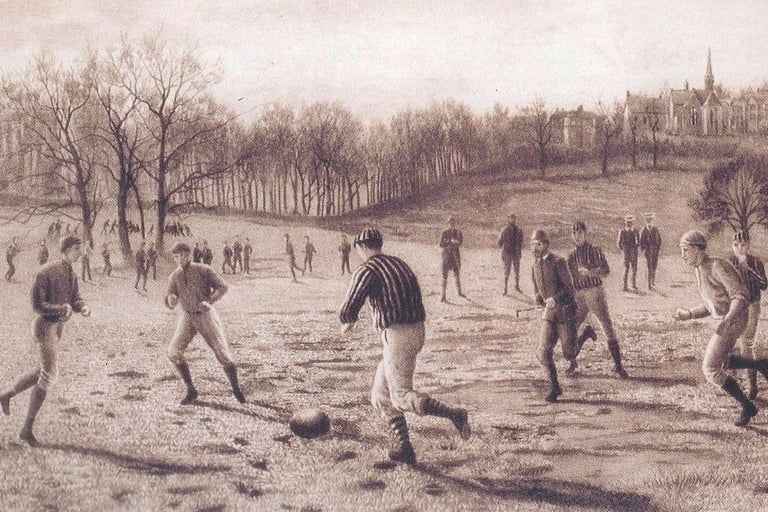
Although the origins of football are lost in history, what we do know is that England invented the modern game. In 1863, the English wrote down a set of rules that form the basis of football as we know it today. One of the key rules was whether players could use their hands. The answer, in fact, created two separate sports: football (no hands) and rugby (hands allowed).
Football was originally popular in private schools and universities like Cambridge, but it quickly spread to all parts of society.
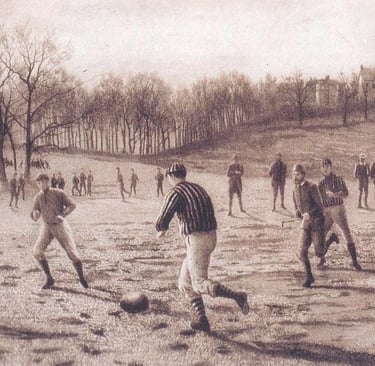
A 19th Century illustration by an Anonymous artist, showing an early game of football
So how did football go from being an English game to a global sport? In the second half of the 19th century, England was probably the richest and most powerful country in the world. The game was first spread by English sailors, who played football on the wharves of ports they visited, fascinating the local people who watched. This is how the game reached Italy, Spain and as far as Argentina. English workers travelling overseas to help build railways and factories also introduced the game to new countries. And overseas students who came to study at English universities took the game home with them when they returned.
You could say that football has been almost as successful an export as the English language itself.
The Birth of the World Cup
At the start of the 20th century, several countries were organising football competitions and playing matches against each other. It seemed like a good idea to create a single organisation to manage the sport around the world — to make sure everyone followed the same rules and to help arrange international matches. In 1904, eight nations founded the Fédération Internationale de Football Association, or FIFA. The first members were France, Belgium, Switzerland, Sweden, Denmark, the Netherlands, Spain and Germany.
Did you notice that there was no England on that list? This was because England felt that they — not FIFA — should manage the game, and so they refused to join. Their refusal didn't last long, and they joined the following year. However, England and FIFA have often had a rocky relationship — England quit FIFA twice more, in 1920 and again from 1928 to 1946.
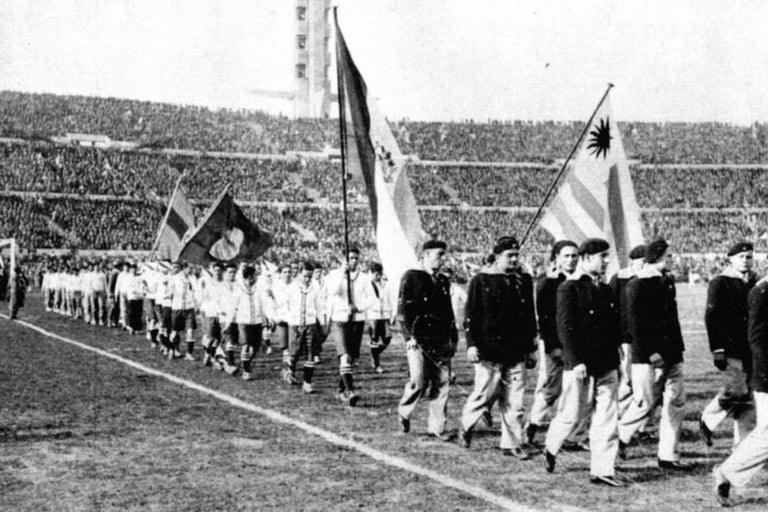
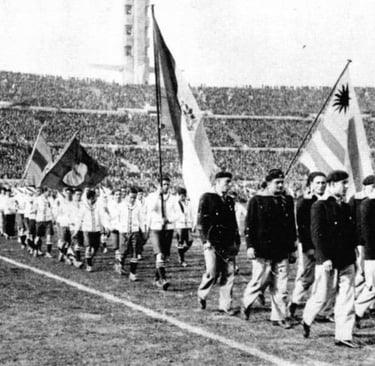
The decision to have a World Cup was made in 1928, and two years later the first tournament took place in Uruguay. Thirteen countries took part, most of them from the Americas, including the United States. Many European countries felt it was too far to travel, and the Great Depression was starting to affect countries’ economies. Nevertheless, four European nations — France, Belgium, Romania and Yugoslavia — made the journey. The hosts, Uruguay, won the first tournament. And once again, the inventors of football were absent: because England had quit FIFA they missed the first three World Cups.
The opening ceremony at the first ever World Cup, in Uruguay in 1930
English-Speaking Countries at the World Cup
Despite missing the first three tournaments, England are the English-speaking country with the most World Cup appearances — 17 in total. They are also the only English-speaking nation to have won the tournament. The United States have the next most appearances (12 times), and their best result was finishing third at the first World Cup.
Scotland have appeared 9 times but have yet to get past the group stage. Australia have qualified 7 times and reached the Round of 16 on two occasions. African nations Nigeria and Ghana — where English is an official language — are also regular participants: Nigeria have appeared 6 times and Ghana 5 times, with Ghana reaching the quarter-finals in 2010. South Africa have appeared 4 times, while Canada, Ireland, Northern Ireland and New Zealand have all qualified 3 times. Both Ireland and Northern Ireland have reached the quarter-finals once. Wales have 2 appearances, while Jamaica and Trinidad and Tobago have each qualified once.
The 2026 World Cup
This year's World Cup is a tournament of firsts. It is the largest ever World Cup, with 48 nations taking part. It is also the first time the tournament has had three host countries. There will also be a record number of games played, 104 matches you can watch. . In comparison, the last World Cup, held in Qatar in 2022, had 64 matches.
This year’s World Cup also has the largest participation of English-speaking countries ever. Eight Anglophone countries are taking part in 2026: England, the United States, Canada, Australia, Scotland, New Zealand, Ghana and South Africa.
English-Speaking Countries at the World Cup: 16 Memorable Moments
Here are sixteen of the most memorable World Cup moments involving Anglophone nations — famous wins, unforgettable goals, and more than a few controversial moments.
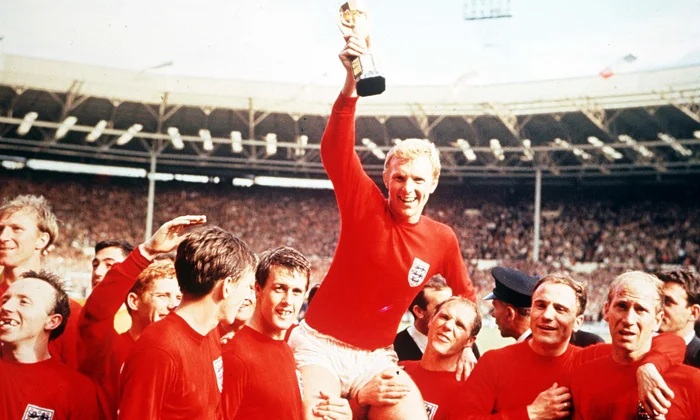
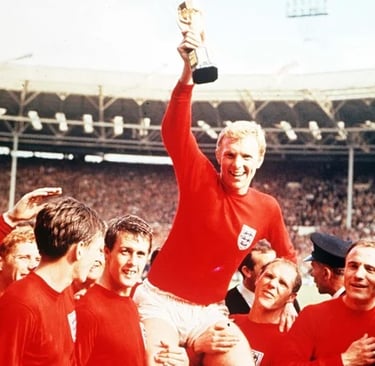
1. England: Without doubt the most memorable moment involving an English-speaking country came in 1966, when England beat West Germany to win the tournament. There’s a famous moment of commentary when the game is in the final moments of extra time. England were ahead 3-2 and attacking. Some fans climbed the fences ready to run on the field and the commentator says “They think it’s over…” — just as striker Geoff Hurst gets the ball and scores goal number four. "It is now!!" the commentator then shouts in triumph.
England captain holds up the World Cup after the final against West Germany that England won 4-2
By the way, this is a case of a famous quote becoming misquoted over time. Some sports commentators use a version of the quote at the end of a close game — "It's not over yet… It is now!!" — but that's not quite what was originally said.
2. United States: Though it happened more than 75 years ago, this 1950 result in Brazil remains one of the greatest shocks in World Cup history. The USA — a team of part-timers — were up against the professionals of England. The English team was known as the “Kings of Football”. Yet the Americans won 1-0. Back in England, the result was so unbelievable that when the score arrived by telegram, some newspapers thought it was a mistake and reported it as a 10-1 win for England. The game is now known as the Miracle on Grass.
3. Northern Ireland: In 1982, little Northern Ireland (population: one and a half million) played the host nation Spain. Nobody gave them a chance. Yet in one of the biggest upsets in World Cup history, Northern Ireland won 1-0, with Gerry Armstrong scoring the only goal. To make the win even more memorable, Northern Ireland did it with ten men for the final 30 minutes after a player was sent off.
4. United States: At the 2010 World Cup, the USA looked to be heading for an early exit in their must-win group game against Algeria. Then, in the 91st minute, Landon Donovan scored. Instead of going home, the Americans progressed to the Round of 16. More importantly, it was the moment that captured the attention of all Americans, not just football fans.
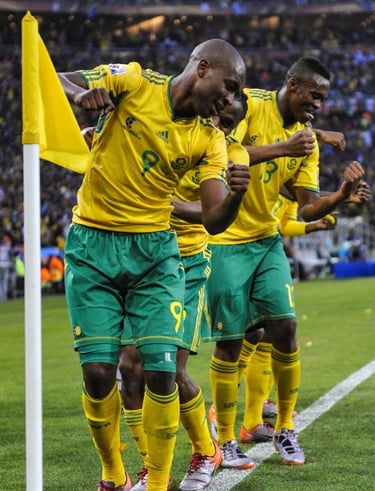
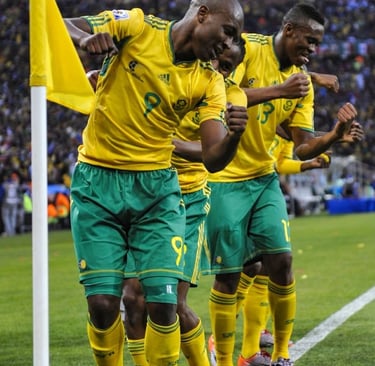
5. South Africa: The 2010 World Cup was memorable for South Africa for many reasons. They hosted the tournament, and anyone who watched it will never forget the buzz of the vuvuzela in the background of every game. South Africa also had an excellent 2-1 victory over tournament favourites France. But the moment everyone remembers is Siphiwe Tshabalala's amazing opening goal — and then the teams’ goal celebration, the Diski Dance, that followed.
6. England: At the 1986 World Cup, Argentina's Diego Maradona scored one of the most controversial goals in history against England, when he punched the ball into the net with his hand. He later called it "the Hand of God." Minutes later, in the same game, he scored what many consider the greatest World Cup goal ever, dribbling past six English players as if they were statues. Argentina won 2-1, and the victory carried extra spice: England had defeated Argentina in the Falklands War just four years earlier.
South African players celebrate with their Diski Dance after Siphiwe Tshabala scored in the 2010 World Cup
7. Scotland: Another memorable upset came in 1978, when Scotland beat Holland 3-2 — and Holland were one of the best teams in the world at the time. One of the Scottish goals, scored by Archie Gemmill, is also one of the best individual goals in World Cup history. Unfortunately for Scotland, the win wasn't enough to see them progress to the next round — they were eliminated on goal difference.
8. United States: Who holds the record for the most saves by a goalkeeper in a single World Cup game? That honour belongs to United States keeper Tim Howard, who made an incredible 16 saves for the USA against Belgium in 2014. Despite Howard's efforts the United States still lost 2-1.
9. New Zealand: Which team was the only unbeaten side at the 2010 World Cup? Not Spain — they lost to Switzerland. Not Holland — they lost the final to Spain. The answer is…New Zealand. The All Whites (the nickname for the New Zealand) played three group games and drew all three — and yet still didn't make it through to the next round, eliminated without losing a game! Football can sometimes be a cruel game.
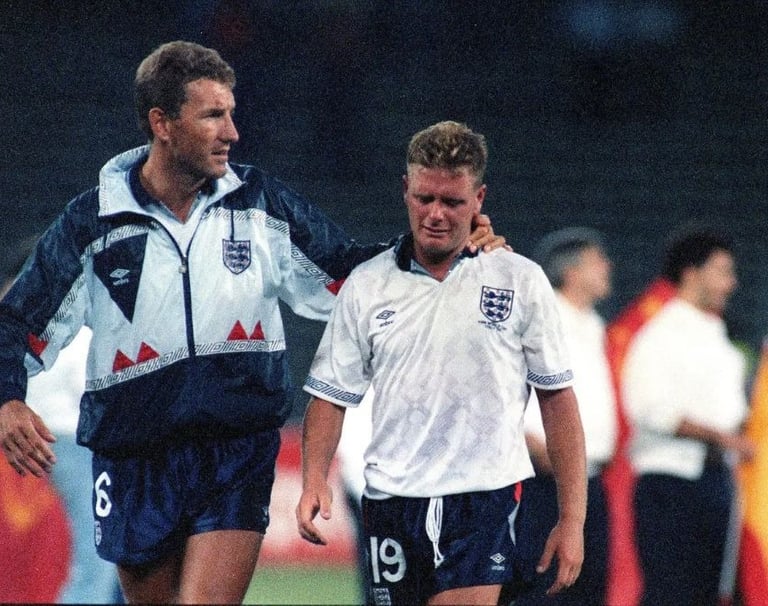
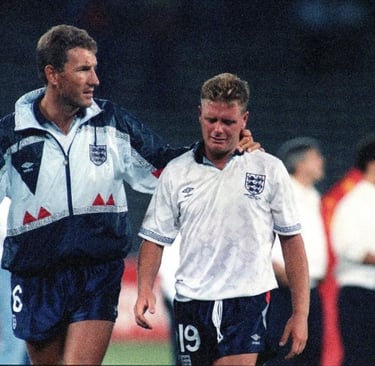
10. England: Older English fans will remember Paul Gascoigne's tears in 1990. Gascoigne was the star midfielder in an England side that made it all the way to the semi-finals. But when he received a yellow card during that semi-final — meaning he would miss the final if England got there — he started crying right there on the pitch. In the end, it didn't matter: England lost the game and didn’t make the final anyway.
11. Ireland: Another big World Cup upset was when Ireland defeated Italy 1-0. What made it extra special was that it was played in New York City, and the stadium was filled with fans of Irish and Italian heritage — immigrants and children of immigrants — experiencing the joy (or despair) of watching the team of their ancestors.
English star midfielder Paul Gascoigne cries after he receives a yellow card in the 1990 World Cup semi-final. He is comforted by team mate, Terry Butcher
12. England: Liverpool’s exciting new talent,18 year old Michael Owen, made an instant impression when he scored a wonder goal in the 1998 World Cup that had fans everywhere talking. What made it especially memorable for English fans was the opponent: arch-rivals Argentina.
13. Australia: Australia's greatest footballer, Tim Cahill, scored one of the World Cup's most spectacular goals in 2014 against the Netherlands. His left-foot volley was so brilliant that even the Dutch fans applauded it. Australia, however, still lost 3-2 and were eliminated.
14. Canada: Canada hasn't had a great lot to celebrate at World Cups — but that changed recently with their big 6-0 win over Qatar. It was their first ever victory at the World Cup. It was a bittersweet occasion, however, as one of their players, Ismael Koné, broke his leg during the game.
15. Australia: Australia were at the centre of one of the biggest refereeing controversies in World Cup history during their 2006 group game against Croatia. English referee Graham Poll gave Croatian defender Josip Šimunić a second yellow card — which meant he should have been sent off. However, the referee made a mistake and didn’t give him a red card. The reason? Šimunić was born and raised in Australia, and when Poll heard his Australian accent, he wrote his name on the wrong side of his notebook. To make matters worse, Poll also disallowed two Australian penalties and blew the final whistle moments before Australia scored what would have been the winning goal. After the game FIFA sent Poll home, and he retired from international football.
16. Ireland: In 2002, Ireland was hoping to have another good World Cup. The Irish had always gone past the Group stage, and even reached the quarter finals in 1990. But those hopes collapsed before a ball was even kicked, when captain and star player Roy Keane had a fight with manager Mick McCarthy. Keane was either sent home or quit the team, depending on who you ask. Ireland still reached the Round of 16 but were knocked out by Spain on penalties. The incident — which took place on the Japanese island of Saipan — became known as the Saipan Incident, and they even made a movie about it!
Why Isn't Football the Number One Sport in Many English-Speaking Countries?
We all known that England is one of the stronger teams in world football. They regularly appear at the World Cup and have even won it once. However, no one thinks of United States or Canada or Australia as great footballing nations. The main reason is simple: in those countries, football isn't the number one sport. But why not?
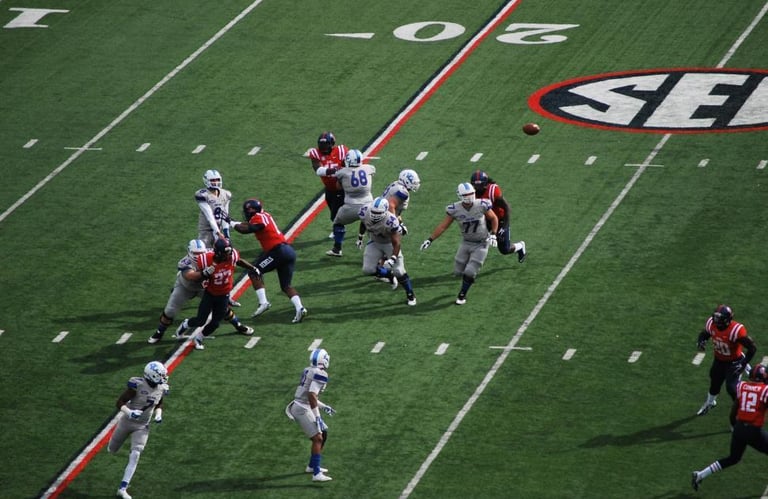
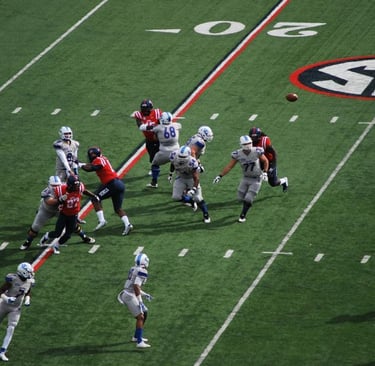
The answer is that football is very popular — it's just a different kind of football! In the United States, Canada, Australia and New Zealand, we even give football a different name – soccer. Instead we call our local games football. In the United States, American football (also known as gridiron, or the NFL) is arguably the most popular sport. In Canada, both American football and Canadian football (which is very similar to the American game) have a lot of fans, though neither is close to ice hockey in popularity.
In the United States, American football (or gridiron) is the country's most watched sport
In Australia, Australian Rules Football (also known as AFL, and also simply known as “the footy”) dominates in most states, and in the north-eastern States, Rugby League is the number one code. In New Zealand, Rugby Union is the top sport — the New Zealand team is the most successful international rugby team in the world.
It should be noted, however, that the popularity of other kinds of football is measured by the number of people who watch. When we look at the number of people who play, the results are quite different. In the United States, almost 17 million people play soccer, compared to fewer than 5 million who play gridiron. In Canada, soccer is the number one sport played by junior players. In Australia it is the top team sport by participation, with 1.1 million active players — ahead of Australian Rules (700,000) and rugby league (500,000). Even in New Zealand, where rugby is king, soccer has recently become the most popular youth team sport. One reason soccer is more popular to play than to watch — especially among children — is that the other codes involve more physical contact and have a higher risk of injury. Many parents feel that soccer is a safer game.
The other big reason for soccer’s lack of popularity is the media. In most English-speaking countries outside England, soccer gets far less attention on television, in newspapers and on sports websites than the local game. In my city for example, the Melbourne newspapers can have four, five or even six pages dedicated to AFL news. Soccer is lucky to get half a page. On a weekend, I can watch four or five AFL games on free-to-air television — but only one soccer match. This means that Australian Rules is always getting more attention and publicity than soccer, helping it to maintain its popularity.
Television plays a big role in keeping gridiron, rugby and Australian Rules popular. These sports work very well on TV. Gridiron, for example, has frequent stoppages and short breaks, which gives TV channels plenty of opportunities to show advertisements. Australian Rules has a similar number of breaks because of the high number of goals scored in a game. This means that these games can be more financially profitable to show than soccer.
Finally, it could be that football/soccer isn’t as popular in some English-speaking countries because, let’s be honest, we’re not as good at it as the Brazilians, Argentinians, French and Germans. In English-speaking countries like United States and Australia, kids who are naturally good at sports often prefer to play the sports they follow on television, and continue playing those sports after they leave school. This means that even though these countries may have players who have skills and natural ability as good as the best football players in the world, they are displaying those skills in front of NFL, rugby or Australian rules crowds.
Finally, there may be one more reason why football is not the number one sport in some English-speaking countries. And that’s because, compared to some other countries, the USA, Canada, Australia and New Zealand aren’t as good at football. And sports fans usually want to see the highest level sport. Countries like Brazil, Argentina, France and Germany have been among the world's strongest football nations for many years. However, in the USA, Canada and Australia, many of the best young athletes in the USA, Canada and Australia never choose football in the first place.
In these countries, talented young people usually play the sports they grow up watching on television. A boy or girl in Melbourne may have the ability to become a great footballer, but instead chooses Australian Rules Football because that is the sport they know and love. In the same way, a young American who could have become an excellent football midfielder may decide to play American football instead. The talent is there — it is simply used in different sports.
Frequently Asked Questions (FAQs)
Why do Americans, Canadians and Australians call it "soccer" instead of "football"?
The word "soccer" was actually first used in England. In the 1860s, two types of football existed in Britain — association football (the round-ball game) and rugby football. People shortened "association" to "soccer" to tell them apart. The word travelled to countries like the USA, Canada and Australia, where it stuck — because those countries already had their own popular sports called "football." Using "soccer" for the round-ball game avoided confusion. Back in England, the word gradually disappeared and "football" took over.
Which country has won the most World Cups?
Brazil is the most successful country in World Cup history, having won the tournament five times — in 1958, 1962, 1970, 1994 and 2002. Germany/West Germany and Italy have each won four times, and Argentina have won three. Among English-speaking countries, England is the only winner, way back in 1966.
How many teams play in the World Cup?
The number of teams has grown over the years. The first World Cup in 1930 had just 13 teams, which grew to 16, then 24, then 32. The 2026 World Cup — hosted by the USA, Canada and Mexico — is the biggest ever, with 48 teams competing. The next World Cup will be in 2030, and FIFA is even thinking about increasing the number to 64 teams to celebrate 100 years of World Cup football.
Which countries have qualified for the World Cup the most times?
Brazil has qualified the most – it is the only country to qualify for every single World Cup — all 23 tournaments between 1930 and 2026. No other country has achieved this. Germany/West Germany and Italy are also among the most consistent qualifiers in World Cup history. Among English-speaking nations, England have qualified for the majority of tournaments since first entering in 1950.
Useful Vocabulary
on the planet: in the whole world
resemble: to look like or be similar to
pitch: the field where football is played
wharf (pl: wharves): a place where boats stop to load and unload people or goods
rocky relationship: a relationship with many problems and disagreements
tournament: a competition with many teams or players
host: the country or city that organises an event. Also a verb – to organise an event in your country or city
qualify: to earn the right to take part in a competition
commentary / commentator: spoken descriptions of a sports game while it is happening / a person who gives sports commentary
extra time: two extra 15-minute periods played if a knockout match is tied after 90 minutes
striker: a player whose main job is to score goals
dribble: to move the ball while running and keeping control of it
eliminated: no longer in a competition because you have lost
save: when a goalkeeper stops the ball from going into the goal
wonder goal: an unusually beautiful or spectacular goal
volley: a shot made before the ball touches the ground
bittersweet: both happy and sad at the same time
disallow: to decide that something, such as a goal, does not count
knocked out: forced to leave a competition after losing (see eliminated above)
code: a type or version of a sport (for example, rugby league or Australian rules football)
free-to-air television: television that anyone can watch without paying a subscription
stoppage: a pause in play because of an injury, substitution, or another delay