Henry VIII and His Six Wives
Discover the story of Henry VIII and his six wives. Learn about his break with the Catholic Church and his lasting impact on England. Clear English for learners.
HISTORY
5/20/202610 min read
Introduction
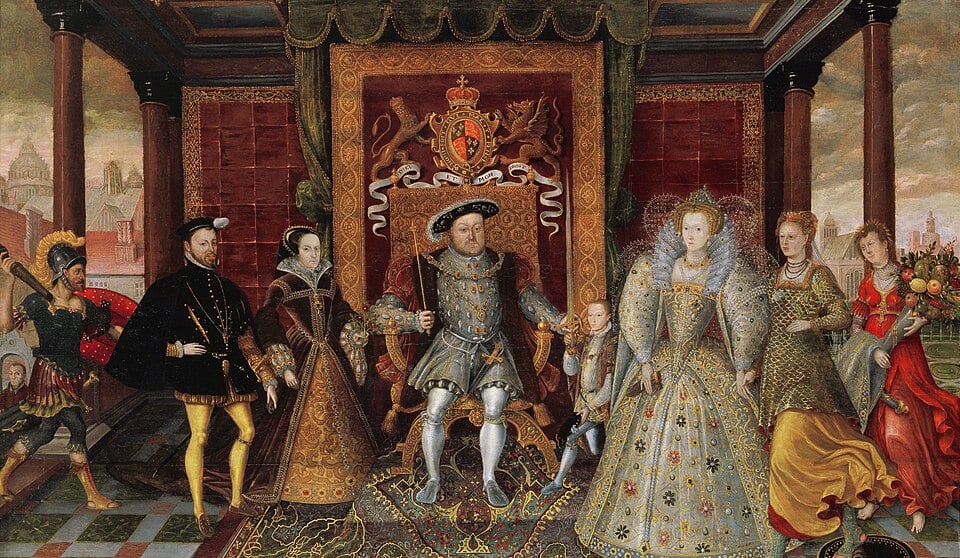
Henry VIII (or Henry the Eighth) is one of the most famous kings in English history. He ruled England for almost 40 years during the 16th century (the 1500s). He is best known for his six marriages. Henry desperately wanted a son to be his heir. When his earlier wives did not give him a son, he either had the marriage annulled or had his wife executed (killed as a legal punishment), and then married again.
His personal life changed English religion and politics. When he became king, England was a Catholic country, which meant the Pope in Rome was the head of the church. However, when the Catholic Church refused to annul his first marriage, Henry found a dramatic solution: he passed a law that made the king — not the Pope — the head of the Church in England. This in effect meant that he had created his own church: the Church of England. As a result of decisions like this, the king became far more powerful during his reign.
This article explains to English learners in clear and simple language, Henry VIII and his wives, the break with the Catholic Church, and the long-term impact. Reading is one of the best ways to build vocabulary and improve your understanding of natural English. It also helps with speaking because you begin to “feel” how English sentences are formed and how common expressions are used in real life.
Henry VIII: A Brief Overview
Henry was born in 1491. His father was Henry VII, King of England. Henry had an older brother called Arthur, but Arthur died at the age of 15. This meant Henry was now next in line to the throne. He became king in 1509 at the age of 17, when his father died.
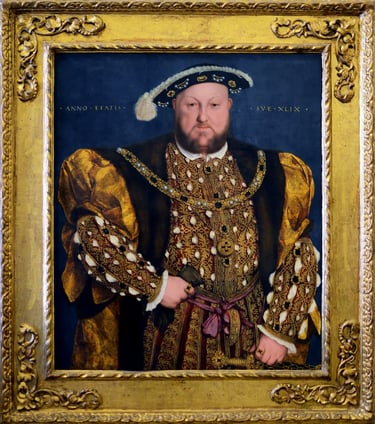
When he first became king, Henry was young, strong, and athletic — full of energy. These were considered excellent qualities for a king in those times, when kings were expected to lead their armies into battle. He was also well-educated, spoke several languages, and enjoyed music and poetry.
However, as he grew older, Henry became more controlling, more suspicious, and wanted more power. People who disagreed with him were often executed, sometimes without even a fair trial. He also became unhealthier over the years — spending too much time drinking, overeating, and spending enormous amounts of money.
His desperate search for a male heir became one of the main problems of his reign.
Portrait of Henry VIII by Hans Holbein
The Six Wives of Henry VIII
Wife #1: Catherine of Aragon (married 1509, annulled 1533)
Catherine had a strong royal background — she was the daughter of the King and Queen of Spain. Spain was one of the most powerful countries in the world at that time. She was first married to Henry’s older brother Arthur, but when Arthur died, Henry’s father arranged for Henry to marry her.
Henry and Catherine were married for over 20 years, but they had no surviving male heir. Catherine gave birth to six children, but only one survived: a daughter named Mary. Henry became increasingly desperate for a son and tried to find a way out of the marriage.
To end the marriage, Henry needed the Pope’s permission for an annulment. When the Pope refused, Henry made the English Parliament pass a law, the Act of Supremacy. This law made the English monarch the “Supreme Head” of the Church of England. This meant he no longer needed the Pope’s permission for anything. Their marriage was annulled, and Catherine was forced to live away from the royal court.
Wife #2: Anne Boleyn (married 1533, executed 1536)
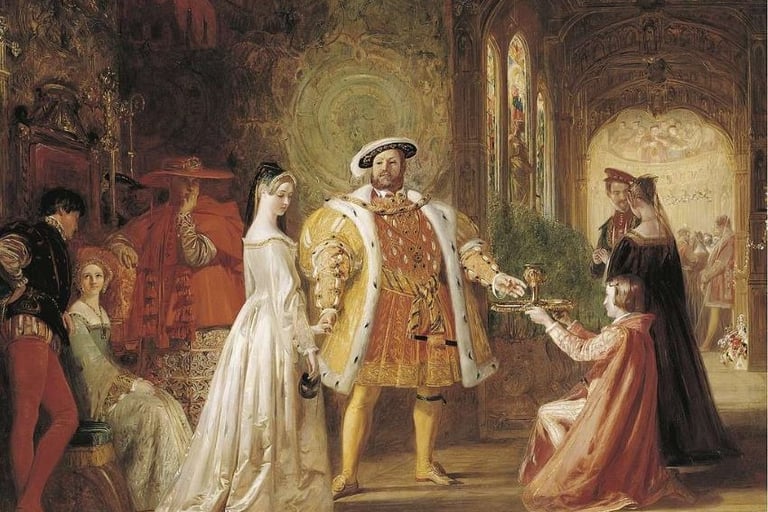
We don’t know for certain when Anne was born. Some historians believe it was 1501, others argue it was 1507. Her father was a diplomat, and she grew up in the royal courts of Europe, spending time in the Netherlands and France. She returned to England as a lady-in-waiting — a kind of personal assistant — to Queen Catherine. It was there that she caught the eye of Henry.
Henry married Anne after leaving Catherine. Anne was highly educated, intelligent, and strong-willed. At first, their marriage was happy. Anne gave birth to a daughter, Elizabeth, though Henry of course wanted a son. She then suffered three miscarriages, and Henry began to lose interest.
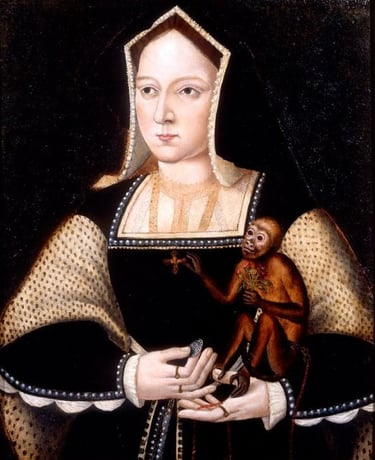
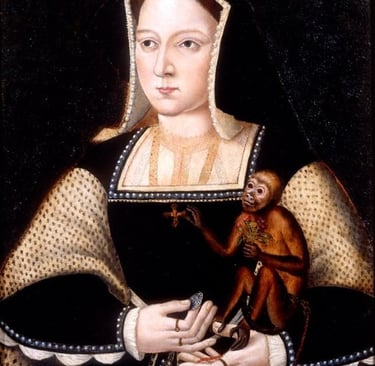
Portrait of Catherine of Aragon by Lucas Horenbout
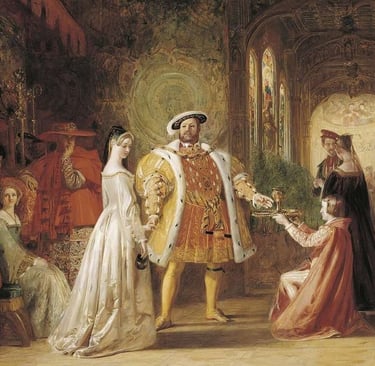
Henry VIII's First Interview with Anne Boleyn, painted by Daniel Maclise
Jane Seymour came from a family of English nobles. Her father had served in the royal court of both Henry VIII and his father before him. Her father served in the court of both King Henry VIII and Henry's father, Henry VII. Jane, too, was a lady-in-waiting for Henry's first wife, Catherine, and may also have been a maid to his second wife, Anne.
Unlike Catherine and Anne, Jane showed little interest in political matters and preferred a quieter, simpler court life. She also cut back on the expensive banquets, parties and lavish spending. She was known for her gentle and kind nature.
A year after her marriage she became pregnant. She gave birth to Edward, Henry’s only legitimate son and the future King Edward VI. However, Jane died just two weeks later after a difficult birth. She was 29 years old. When Henry himself died years later, he requested to be buried beside Jane, the wife who had finally given him a son.
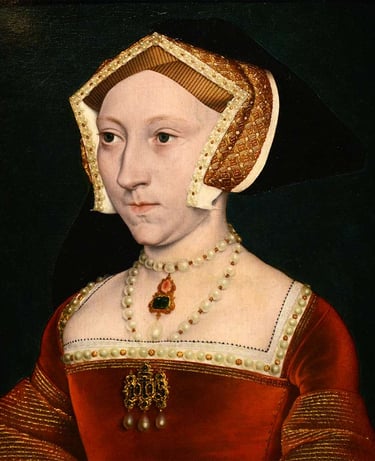
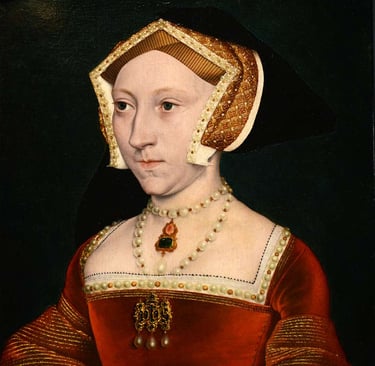
Portrait of Jane Seymour by Hans Holbein the Younger
Wife #3: Jane Seymour (married 1536, died 1537)
Wife #4: Anne of Cleves (married January 1540, annulled July 1540)
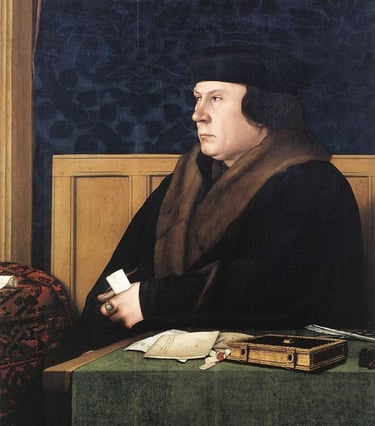
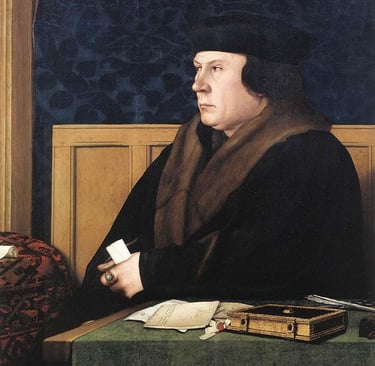
This was a political marriage. Anne was born in the German city of Düsseldorf, then part of the Holy Roman Empire. Henry’s chief advisor, Thomas Cromwell, arranged the match in the hope of forming a political alliance with Protestant princes in Europe.
Henry had only seen a beautiful portrait of Anne before they met. However, when he saw her in person, he was deeply disappointed. He found her very different from the portrait and called the marriage off as quickly as possible — it was annulled after just six months. Anne herself accepted the situation quietly and lived comfortably in England for the rest of her life.
Thomas Cromwell, who arranged the marriage, was not so fortunate. Henry was so furious that he had Cromwell arrested and executed for treason later that same year.
Thomas Cromwell, painted by Hans Holbein the Younger
Wife #5: Catherine Howard (married 1540, executed 1542)
Catherine Howard was young, lively, and attractive. She was the niece of Thomas Howard, the Duke of Norfolk, a powerful and ambitious nobleman at Henry’s court. The Duke had been an enemy of Thomas Cromwell, and he used the king’s interest in Catherine to become more powerful.
At first, Henry thought very highly of Catherine, gave her expensive gifts and said he had never known a woman like her. She was only around 17 or 18 when they married (he was almost 50 years old).
The marriage, however, did not end well. Catherine had a secret affair with a young man closer to her own age, and her family’s enemies used this information to destroy both her and her family’s power at court. She was arrested for treason and executed in February 1542, only around 18 months after her marriage. Her story shows how dangerous Tudor court life could be, as powerful families plotted against each other for influence and survival.
Wife #6: Catherine Parr (married 1543–1547 (Henry's death)
Catherine Parr was Henry’s sixth and final wife. She had been married twice before – both husbands died, allowing her to re-marry. Catherine and Henry were married for four years, until Henry’s death in 1547.
Catherine was intelligent, well-educated, and sensible. She helped care for Henry’s three children — Mary, Elizabeth, and Edward — and played an important role in their education. She also helped repair the relationships between Henry and his daughters, who had been treated poorly for much of their lives. She helped rule the country when Henry was away.
Catherine was also a writer. She wrote three books and was the first woman in English history to have a book published under her own name.
After Henry's death, Catherine married again for a fourth time and gave birth to a daughter. Tragically, she died a week after the birth.
Henry’s Impact on England
Henry VIII has been the popular image of an English king — powerful, imperious, and larger than life. Although Henry VIII is often remembered for his six wives and dramatic personal life, his importance in English history goes far beyond his marriages.
The Church of England
Henry’s decision to break with the Roman Catholic Church and create the Church of England changed the country forever. This religious change is known as the English Reformation. It affected not only religion, but also politics, education, culture, and daily life for centuries to come.
The Power of the Monarchy and Parliament
Henry’s reign also helped strengthen the power of the English monarchy. He took power away from the old noble families and took much of the Catholic Church’s wealth and land by closing England’s monasteries and transferring its enormous riches to the Crown and to a new class of landowners.
However, Henry’s actions also had unintended consequences. Because he needed Parliament to pass his religious laws, he actually made Parliament more important. This was one of the first steps towards the parliamentary democracy that Britain has today.
England’s Place in the World
By starting his own church, Henry also changed England’s relationship with the rest of Europe. England became isolated from the great Catholic powers of France and Spain, and developed a strong sense of itself as an independent nation. This sense of independence and separateness from continental Europe has remained a part of British culture and politics ever since.
His Children’s Reigns
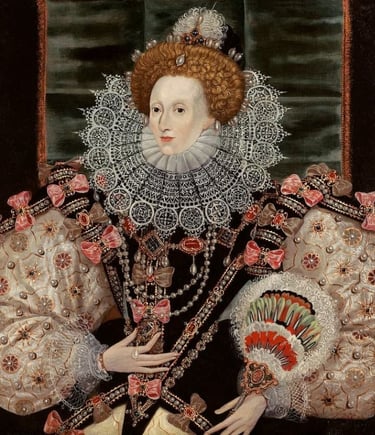
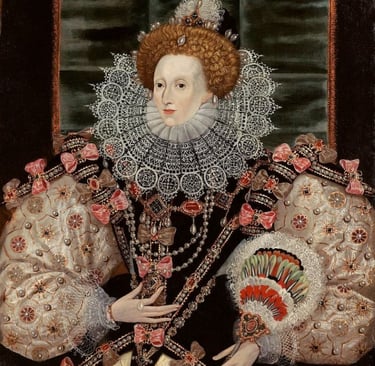
Henry’s three children all became rulers, and each had an important part to play in English history. Edward VI continued to strengthen the Protestant religion. Mary I tried to return England to Catholicism, causing great suffering and violence in the process. And Elizabeth I, the daughter of Anne Boleyn, went on to rule for almost 50 years, overseeing one of the most celebrated periods in English history and establishing England as a major world power.
Henry VIII remains one of the most recognisable figures in world history. His reign transformed England from a minor Catholic kingdom into an independent Protestant nation on the edge of becoming a global power.
Henry VIII's daughter, Elizabeth, who became one of England's longest-reigning rulers
Useful Vocabulary
• heir – a person who will legally receive someone’s title, property, or position when they die. A king’s heir is the person who will become the next king or queen.
• annul – to legally cancel a marriage, as if it had never happened.
• in effect – used to describe the real result or meaning of something, even if it is not stated directly. Example: “He was, in effect, creating a new church.”
• reign – the period of time during which a king or queen rules a country. Also used as a verb: “Henry reigned for 38 years.”
• in line to the throne - the order of people who will become king or queen if the current monarch dies. The person who is first in line will become the next ruler.
• monarch – a king or queen. The system of government led by a monarch is called a monarchy.
• court – the group of people who live and work around a king or queen — including advisors, servants, nobles, and ladies-in-waiting. Also refers to the place where the monarch lives and governs.
• to catch the eye of – to attract someone’s attention or interest, usually because of physical appearance.
• miscarriage – when a pregnancy ends naturally before the baby is developed enough to survive. This was tragically common in the 16th century.
• nobles – people from the highest social classes in a country — below the royal family but above ordinary people. They often held titles such as Duke, Earl, or Baron.
• political – connected to government and power
• lavish – very grand, expensive, and impressive. Often used to describe parties, spending, or gifts. Example: “lavish banquets.”
• Protestant – a member of a branch of Christianity that separated from the Roman Catholic Church in the 16th century. The Church of England is a Protestant church.
• affair – a secret romantic or sexual relationship between two people, when at least one of them is already married to someone else.
• to plot – to secretly plan something, often something harmful or illegal.
• imperious – behaving as if you are much more important than other people; expecting to be obeyed without question.
• The Reformation – the major religious change in 16th-century Europe, during which many countries broke away from the Roman Catholic Church and formed new Protestant churches.
• unintended consequence – a result of an action that was not planned or expected — and which may be positive or negative.
• isolated – separated from others; having little connection or communication with the wider world.
Frequently Asked Questions (FAQs)
How many wives did Henry VIII have?
Henry VIII had six wives in total: Catherine of Aragon, Anne Boleyn, Jane Seymour, Anne of Cleves, Catherine Howard, and Catherine Parr. Two were executed, two marriages were annulled, one wife died after childbirth, and one — Catherine Parr — outlived Henry.
Why did Henry VIII break with the Catholic Church?
Henry wanted to annul his first marriage to Catherine of Aragon, who had not given him a male heir. The Pope refused to grant the annulment, partly because Catherine was the aunt of the Holy Roman Emperor — a powerful ally the Pope did not want to offend. Henry’s solution was to remove the Pope’s authority in England entirely and make himself the head of the Church of England instead.
Which of Henry’s wives had children?
Three of Henry’s six wives had children. Catherine of Aragon gave birth to a daughter, Mary, who later became Queen Mary I. Anne Boleyn had a daughter, Elizabeth, who became the famous Queen Elizabeth I. Jane Seymour gave Henry the son he had always wanted — Edward, who became King Edward VI. All three of Henry’s legitimate children eventually ruled England, one after another.
Why is Henry VIII so famous?
Henry VIII is famous for several reasons. Most people know him because of his six marriages and the dramatic fates of his wives. But his historical importance goes much deeper. He changed England’s religion by creating the Church of England, started the English Reformation, strengthened the power of Parliament (even though that was not his intention), and transformed England into a more powerful and independent nation. He also shaped the popular idea of what an English king looks like — powerful, dominant, and larger than life. He remains one of the most recognisable historical figures in the world.